Defining OER
Open Educational Resources (OER) are teaching, learning, and research resources that reside in the public domain or have been released under an intellectual property license that permits repurposing by others.
What are OER?
The William and Flora Hewlett Foundation provides the following definition of open educational resources:
“OER are teaching, learning, and research resources that reside in the public domain or have been released under an intellectual property license that permits their free use and re-purposing by others. Open educational resources include full courses, course materials, modules, textbooks, streaming videos, tests, software, and any other tools, materials, or techniques used to support access to knowledge.”
In other words, “OER” is a very broad term. We apply it to anything that helps students master course concepts.
The key distinguishing factor is the copyright status of the material. If the course content is copyrighted under traditional, all-rights-reserved copyright, then it’s not OER. If it resides in the public domain or carries Creative Commons or similar open copyright status, then it is OER.
The 5 Rs of OER
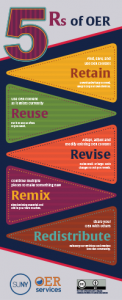
A useful way to appreciate the value of OER is to understand what you, the user of openly licensed content, are allowed to do with it. These permissions are granted in advance, and are legally established through Public Domain or Creative Commons copyrights:
- Retain – the right to make, own, and control copies of the content (e.g., download, duplicate, store, and manage)
- Reuse – the right to use the content in a wide range of ways (e.g., in a class, in a study group, on a website, in a video)
- Revise – the right to adapt, adjust, modify, or alter the content itself (e.g., translate the content into another language)
- Remix – the right to combine the original or revised content with other material to create something new (e.g., incorporate the content into a mashup)
- Redistribute – the right to share copies of the original content, your revisions, or your remixes with others (e.g., give a copy of the content to a friend)
This material is adapted from original writing by David Wiley, which was published freely under a Creative Commons Attribution 4.0 license at http://opencontent.org/definition/.

Download the 5 Rs of OER Infographic
Examples of OER
Examples of OER
Types of OER include (but are not limited to) syllabi, lesson plans, learning modules, lab experiments, simulations, course videos, discussion prompts, assignments, assessments, library guides, and course design templates.
Faculty
Many faculty already use OER in their classes — showing YouTube videos, using worksheets created and shared by other faculty, and using online simulations as learning activities. Faculty can create and share syllabi, lesson plans, and even full textbooks for their courses. They can collaborate with faculty at their own institutions or other institutions around the world. They can access and remix existing OER and republish them to share with others.
Students
Students can play a significant role in creating OER as well — from simple assignments to full textbooks. As an example, at the University at Buffalo (SUNY), students in Jessica Kruger’s public health course worked in groups and together to research, write, and create a full OER textbook. The result became the book Models and Mechanisms of Public Health. The book will live on in upcoming semesters as future students edit and provide updated content to the book as needed.
Instructional Designers
Instructional Designers can work with faculty and students to integrate OER into teaching and learning, and can also share and publish their course design templates as OER. Many instructional designers and technologists work with librarians and IT services to help integrate OER into learning management systems and other course learning platforms.
Librarians
Librarians play a key role in OER initiatives – advocating, developing, exploring, and managing OER. Along with helping you find OER, librarians can help you better understand copyright and licensing concepts, and guide you through your Creative Commons licensing options if you choose to create materials yourself.
As the use of OER becomes more widespread, we have access to more repositories where you can search for OER. Keep in mind that while you may not find OER that perfectly suit your needs, most OER can be modified and customized to fit within the context of your course, or meet the needs of your students. Yes, that takes time and consideration, but that time and consideration can greatly benefit your own teaching and research, as well as the overall learning experience that your students have.
OER Licensing
Going back to our definition, we need to remember that OER are resources that reside in the public domain or have been released under an intellectual property license that permits their free use and re-purposing by others.
The most commonly used intellectual property license for OER that permits free use and re-purposing is called Creative Commons Licensing. Creative Commons licenses work with legal definitions of copyright to automatically provide usage rights pertaining to that work.
As you progress along your learning journey, you will have the opportunity to fully explore Creative Commons licensing and learn how to apply appropriate licenses to the OER you and your learners create and use.
Leveraging the Benefits of OER
Leveraging the Benefits of OER
Why use OER?
OER supports a future where students and instructors have free access to a wide variety of high-quality educational resources that have been collaboratively developed, reviewed, revised, and shared across institutions. A future where educational resources can be easily adapted to fit within the context of specific courses and to meet the needs of specific students. A future where the cost of creation, use, and maintenance is much lower than the current rising costs of textbooks and other classroom resources.
Take some time to listen to stories from instructors at SUNY Canton:
Benefits for Students
Using OER can provide tremendous cost savings for students as well as impact student success and completion rates. The cost of textbooks can be a huge financial burden on students, which not only affects student success but could also delay graduation for students who are taking fewer classes per term because of that cost, further increasing financial costs for students over time. OER provide students with day-one access to free course materials, and research reviewed by the Open Education Group shows that most students perform as well or better using OER course materials compared with students using traditional textbooks.
Open Educational Resources allow students to have learning materials as soon as the course starts, so they can make the most of them to support their learning. They no longer have to wait for financial aid disbursements or delayed shipments from online orders.
This is not a negligible point, as recent results of Florida Virtual Campus’ 2022 Student Textbook and Course Materials Survey show:
- 53.5% of surveyed students did not purchase a required textbook because of the cost, which these students felt resulted in them earning a poor grade (32.4%).
- 43.7% of students surveyed also indicated that they have taken fewer courses.
Because of the cost of required textbooks,
- 38.5% did not register for a specific course
- 24.2% dropped a course
Benefits for Faculty
Faculty using OER enjoy great freedom in selecting course materials and can customize these materials to fit the specific needs of their students and the goals of their classes. Since most OER permit adaptation, educators are free to edit, reorder, delete from, or remix OER materials.
Listen to this OER Stories podcast to learn more about the benefits of using OER from Lorena Mathien, Assistant Professor in the Business Department at SUNY Buffalo State.
Use, Improve, and Share
- Save time and energy by adapting or revising resources that have already been created
- Tailor resources to fit specific context within your courses and research
- Expand interdisciplinary teaching by integrating resources from multiple sources
Network and Collaborate with Peers
- Access educational resources that have been peer-reviewed by other experts in your field
- Explore reviews and annotations that provide more in-depth knowledge of the resource
- Collaborate on creating new resources that can be used within or across disciplines
Lower Costs and Improve Access to Information
- Reduce the cost of course materials
- Enable all students to have equal access to course materials
- Provide students with the opportunity to explore course content fully before enrolling
Exploring Supporting Research
Take some time to explore these articles and reviews of research on OER to learn more about impact of integrating OER into your work.
OER: Bigger Than Affordability
In this article from Inside Higher Ed Open, Robin DeRosa shares her views on how OER can catalyze a much-needed national conversation about what we mean by “public” higher education.
Attributes of Open Pedagogy: A Model for Using Open Educational Resources
In this article, Bronwyn Hegarty establishes a rationale for the term open pedagogy, and, using current research, presents eight attributes of open pedagogy grounded in the concept of openness and Open Educational Practice.
Hilton, J. (2016) Open educational resources and college textbook choices: a review of research on efficacy and perceptions. Education Tech Research and Development, 64(4), 573 – 590.
This review of research synthesizes the results of 16 studies that examine either (1) the influence of OER on student learning outcomes in higher education settings or (2) the perceptions of college students and instructors of OER. Results across multiple studies indicate that students generally achieve the same learning outcomes when OER are utilized and simultaneously save significant amounts of money.
Inequitable Impacts of Textbook Costs at a Small, Private College: Results from a Textbook Survey at Gettysburg College. Open Praxis, vol. 13 issue 1, January–March 2021, pp. 69–87.
Recognizing that higher education settings vary considerably, librarians at Gettysburg College sought to better understand textbook spending behaviors and the effects of costs on our students. We adapted the Florida Virtual Campus 2016 Student Textbook and Course Materials Survey to suit the context of our small, private, liberal arts college. Most students spent $300 in Fall 2019. Financial aid awards did not cover the cost of required books and course materials for most students receiving aid. Negative effects were more pronounced for first-generation students and Pell Grant recipients, who were more likely to not purchase required books, to not register for a course due to cost, and to struggle academically. Some reported negative effects beyond their academic lives, as well. We recommend adoption of Open Educational Resources as an equity-minded practice that addresses this academic success barrier.
Check Your Understanding 1
Identifying, Finding, and Adopting OER
Recognizing Different Types of OER
Remember, OER refer to educational materials that include permission for anyone to use, modify and share. In its simplest form, the term OER describes any educational resources (including curriculum maps, course materials, textbooks, streaming videos, multimedia applications, podcasts, and any other materials that have been designed for use in teaching and learning) that are openly available for use by educators and students, without an accompanying need to pay royalties or license fees.
Materials that are under full copyright, or which are not accompanied by a specific license allowing anyone to copy, adapt and share them, are not Open Educational Resources. You can use these materials only within fair use provisions or copyright exceptions.
According to Schaffert & Geser, 2008; OLCOS Roadmap, 2012, the core characteristics of OER are:
- Open Access: Content is provided free of charge for educational institutions, content services and users such as teachers, students and lifelong learners.
- Open Format: Content is produced in open format with functionalities that allows for easy re-use.
- Open License: Liberal licenses to enable re-use combine and re-purposing of content.
- Open Software: Produced with open-source software.
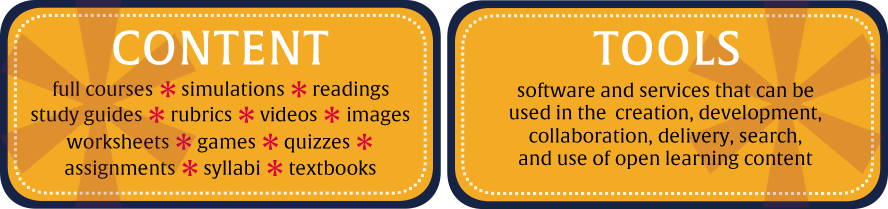
To simplify things, you can think of OER falling into the category of either content or tools:
Using OER Search Utilities and Services
There are billions of openly licensed materials available on the web, so how do you go about finding the right OER for your needs?
Watch this video by Amy Hofer, Statewide Open Education Library Services Coordinator, Open Oregon, to learn how to save time searching so you can spend more time designing your course to use open materials. Remember that an open license gives you many possible ways to legally re-purpose the materials you find.
Using Google Advanced Search
The Google search engine has an ‘advanced search’ that lets you search by ‘usage rights’ for content published to the Internet under an open license. The Advanced Search dialogue can be found under the Settings function or can be directly accessed at http://www.google.com/advanced_search
Using OER Repositories
Searching an OER Repository can result in a faster and more productive search experience since the resources have been curated and organized into various categories including discipline, format, and open license. Many repositories have either peer reviews or a rating scale where users have shared their perception or experience with the resource.
You can begin your search for OER at OER Commons. You can also contact the ACA Open & Affordable Resources Initiative for help finding and integrating OER into your work.
You can also explore a vast list of OER Repositories and other search utilities on the Community College Consortium for Open Educational Resources site.
Other OER Search Resources
Over 100,000 OER resources searchable by discipline. MERLOT search interface includes many filtering tools and also aggregates search results from other repositories and the web.
OASIS Search
Openly Available Sources Integrated Search (OASIS) is a search tool that aims to make the discovery of open content easier. OASIS currently searches open content from 115+ different sources and contains over 455,000 records. OASIS is maintained at SUNY Geneseo’s Milne Library.
Evaluating the Quality of OER
Once you have found an appropriate OER, take time to evaluate it to see if it meets your criteria based on content, presentation, online accessibility, production options, platform compatibility, delivery options, interactivity, consistency between online and printed versions, and available ancillary material such as test banks or presentations.
These questions can help guide you when evaluating OER:
Clarity, Comprehensibility, and Readability
Is the content, including any instructions, exercises, or supplemental material, clear and comprehensible to students?
Is the content well-categorized in terms of logic, sequencing, and flow?
Is the content consistent with its language and key terms?
Content Accuracy and Technical Accuracy
Is the content accurate based on both your expert knowledge and through external sources?
Are there any factual, grammatical, or typographical errors?
Is the interface easy to navigate? Are there broken links or obsolete formats?
Adaptability and Modularity
Is the resource in a file format which allows for adaptations, modifications, rearrangements, and updates?
Is the resource easily divided into modules, or sections, which can then be used or rearranged out of their original order?
Is the content licensed in a way which allows for adaptations and modifications?
Appropriateness
Is the content presented at a reading level appropriate for higher education students?
How is the content useful for instructors or students?
Is the content itself appropriate for higher education?
Accessibility
Is the content accessible to students with disabilities through the compatibility of third-party reading applications?
If you are using Web resources, does each image have alternate text that can be read?
Do videos have accurate closed-captioning?
Are students able to access the materials in a quick, non-restrictive manner?
Supplementary Resources
Does the OER contain any supplementary materials, such as homework resources, study guides, tutorials, or assessments?
Have you reviewed these supplementary resources in the same manner as the original OER?

Download a .PDF of these criteria from Affordable Learning Georgia
OER Evaluation Rubrics
You can explore these rubrics to guide your evaluation of OER:
OER Assessment Rubric
This rubric is developed by Sarah Morehouse with help from Mark McBride, Kathleen Stone, and Beth Burns and is licensed under a Creative Commons Attribution 3.0 Unported License.
Rubrics for Evaluating Open Education Resources Objects
This packet includes 8 separate rubrics for the evaluation of OERs created by ACHIEVE.org.
BC Open Textbooks Review Criteria
This guide is specific to the evaluation of open textbooks.
More to Explore
More information about the definitions of Open Educational Resources can be found on the Creative Commons Wiki: and in David Wiley’s post on freedoms in OER.
For a philosophical perspective, read through the article Emotional Ownership as the Key to OER Adoption: From Sharing Products and Resources to Sharing Ideas and Commitment across Borders.
Customizing and Integrating OER
The next step is to determine if you want to use the OER as is or modify it. One of the benefits of OER is the flexibility to modify and customize them for specific course designs as much or as little as you desire.
Many faculty feel driven to create the “perfect” resources for their classes and it can be difficult to put aside that perfection and use other people’s creations. However, the number, variety, and quality of OER available freely is such that anyone should be able to find resources they can readily (with or without adaptations) put to use within their classrooms. And adaptation or adoption of OER will almost always be more time-efficient than creating teaching materials from scratch.
Keep these things in mind when you are customizing an OER, and creating a derivative work:
- Check the license on the OER you want to use to be sure that it allows for derivative works.
- Consider your options for applying a Creative Commons license to your OER so that others can access, use, and modify it.
- Keep accessibility in mind. If the OER you are using does not meet accessibility guidelines at your institution, take some time to make your customized, derivative work accessible to all learners.
Understanding Creative Commons Licensing
If you decide to customize OER, you need to take the Creative Commons license type, the format of the material, and potential hosting for a new digital version into consideration.
General rights for copying and repurposing are what make OER different from any other educational resources available online free of charge. In the case of Open Educational Resources, all users are given the right to copy and repurpose without needing to request permission from copyright holders (as long as they adhere to license conditions, such as attribution); the users’ rights are clearly specified and easily understandable. Most OER materials are published under free Creative Commons licenses or are available in the Public Domain.
Watch this video short animation video that explains the Creative Commons licenses:
The Licenses
Attribution (CC BY): This license lets others distribute, remix, tweak, and build upon your work, even commercially, as long as they credit you for the original creation. This is the most accommodating of licenses offered. Recommended for maximum dissemination and use of licensed materials.
Attribution-ShareAlike (CC BY-SA): This license lets others remix, tweak, and build upon your work even for commercial purposes, as long as they credit you and license their new creations under the identical terms. This license is often compared to “copyleft” free and open-source software licenses. All new works based on yours will carry the same license, so any derivatives will also allow commercial use. This is the license used by Wikipedia and is recommended for materials that would benefit from incorporating content from Wikipedia and similarly licensed projects.
Attribution-NoDerivs (CC BY-ND): This license allows for redistribution, commercial and non-commercial, as long as it is passed along unchanged and in whole, with credit to you.
Attribution-NonCommercial (CC BY-NC): This license lets others remix, tweak, and build upon your work non-commercially, and although their new works must also acknowledge you and be non-commercial, they don’t have to license their derivative works on the same terms.
Attribution-NonCommercial-ShareAlike (CC BY-NC-SA): This license lets others remix, tweak, and build upon your work non-commercially, as long as they credit you and license their new creations under identical terms.
Attribution-NonCommercial-NoDerivs (CC BY-NC-ND): This license is the most restrictive of the six main licenses, only allowing others to download your works and share them with others as long as they credit you, but they can’t change them in any way or use them commercially.
Note that every CC license except the non-derivative license allows for modifications!
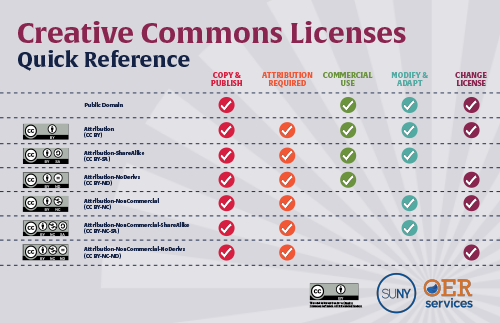
Download a .pdf of this Creative Commons Licenses Quick Reference
Working with Different OER Formats
If the open material is available in an editable format, then the easiest approach may be to use the same tool as the original author to add, delete, or modify it. Consulting course support services (such as your institution’s instructional design team) is recommended, particularly if you have not done this kind of work before. They can make you aware of tools that will streamline this process.
If you are remixing multiple OER in different formats, then you will have to decide which format you want for your final product, and convert the remaining resources to this format for remixing.
Integrating OER Into Your Course
There are several stakeholders on campus involved in delivering instructional materials to students, including the bookstore, library, IT help desk, and possibly on-site print services. It is important to engage these stakeholders in your move to OER as they can all assist in the smooth delivery of open materials to students.
Note that MHU has a policy requiring faculty to notify the bookstore of any textbooks required for courses they are teaching by a certain date.
The simplest and most economical method of delivering OER to students is to integrate OER into your campus Learning Management System (LMS).
You can also provide a link for students to view or download the OER. Most open textbooks are available in different downloadable formats, such as PDF, ePub, mobi, or DAISY formats. Keep in mind that certain formats may be preferable for students with visual impairments. Downloadable options may also be useful for students without reliable Internet access, as they can download the material to their computers or mobile devices for offline access. This will also allow students to continue to access OER materials after the course ends.
Low-cost printing is another option for open textbooks. Some OER textbook providers offer low-cost printing services directly from their websites, in which case you may be able to work with your institution’s bookstore to acquire printed copies. Other printing options could include institutional printing services or students using their printing allowances to print chosen sections of the textbook.
Embracing Open Pedagogy
If a central gift that OER brings to students is making college more affordable, one of the central gifts that it brings to faculty is agency. OER can help us rethink our pedagogies in ways that center on access. We can ask broader questions that go beyond “How can I lower the cost of textbooks in this course?”
There are many ways to begin a discussion of “Open Pedagogy.” Although providing a framing definition might be the obvious place to start, we want to resist that for just a moment to ask a set of related questions:
- What are your hopes for education, particularly for higher education?
- What vision do you work toward when you design your daily professional practices in and out of the classroom?
- How do you see the roles of the learner and the teacher?
- What challenges do your students face in their learning environments, and how does your pedagogy address them?
This recording from February 2019 was the kick-off of the Open Pedagogy Webinar series, co-hosted by the SUNY Center for Professional Development and the Open Education Consortium. It features a lively conversation between Robin DeRosa and Rajiv Jhangiani, two prominent advocates for OER and Open Pedagogy.
Revising Your Pedagogy as Learner-Centered
When faculty use OER, we aren’t just saving a student money on textbooks: we are directly impacting that student’s ability to enroll in, persist through, and successfully complete a course. In other words, we are directly impacting that student’s ability to attend, succeed in, and graduate from college.
When we talk about OER, we bring two things into focus: that access is critically important to conversations about academic success, and that faculty and other instructional staff can play a critical role in the process of making learning accessible.
Using OER the same way we used commercial textbooks, however, misses the point. It’s like driving an airplane down the road. Yes, the airplane has wheels and is capable of driving down on the road (provided the road is wide enough). But the point of an airplane is to fly at hundreds of miles per hour – not to drive. Driving an airplane around, simply because driving is how we always traveled in the past, squanders the huge potential of the airplane.
So what sets OER apart from commercial textbooks and other commercial resources? OER are free to access, free to reuse, free to revise, free to remix, and free to distribute.
The question becomes, then, what is the relationship between these additional capabilities and what we know about effective teaching and learning? How can we extend, revise, and remix our pedagogy based on these additional capabilities?
The Disposable Assignment
The notion of the “disposable assignment” comes from David Wiley, Chief Academic Officer Lumen Learning. Wiley refers to these as assignments that students complain about doing and faculty complain about grading. A student may spend three hours creating it, a teacher spends 30 minutes grading it, and as soon as the project is handed back, the student throws it away.
Open Pedagogy considers a more renewable approach – embracing assignments and activities where students create materials that are shared with their peers, and other students taking the same class at your institution or around the world! This learner-generated content can enhance student engagement, and, as Wiley puts it, “make the world a better place.”
An Approach of Open Pedagogy
We can think about Open Pedagogy as an access-oriented commitment to learner-driven education AND as a process of shaping our teaching approaches and using tools for learning that enable students to contribute by creating and sharing learning content.
Examples of Open Pedagogy in Practice
- Students create tutorial videos for a particular topic or assignment. These tutorial videos could cover a wide range of topics such as teaching specific skills, summarizing key concepts, providing worked examples, or creating connections to student lives.
- Students create written or video-based presentations that summarize key aspects of the storyline, character, interpretation, symbolism, etc. These summaries could be both used by and improved upon by future generations of learners.
- Students create worked examples that provide other students with step-by-step templates of how to do problems, specifically in topics that have proven troublesome to students in past semesters. These are particularly popular in math courses.
- Students explain how principles studied in class are exemplified in popular media like movies, television, music, or books.
- Students create games to be played by future generations of learners to help them prepare for, or deepen their learning on, specific topics.
- Students create guides to direct other students through readings or lectures.
The exciting aspect of renewable assignments is that, once they’re shared online, they can reach a wide audience of users who might benefit from them. Students recognize this expansive potential audience, and are inspired to work to anticipate the needs of this audience in ways they might not otherwise for a typical class project. They also will potentially emerge from the class with a published work bearing their name, which can be added to a résumé or portfolio.

You can also build OER with your students. Though students may be beginners with most of the content in your course, they are often more adept than you at understanding what beginning students need in order to understand the material. Asking students to help reframe and re-present course content in new and inventive ways can add valuable OER to the commons while also allowing for the work that students do in courses to go on to have meaningful impact once the course ends.
Ask critical questions about “open.” When you develop new pathways based on Open Pedagogy, pay special attention to the barriers, challenges, and problems that emerge. Be explicit about them, honest about them, and share them widely with others working in Open Education so that we can work together to make improvements.
More to Explore:
April Open Perspective: What is Open Pedagogy?
This post, part of the Open Pedagogy Notebook, shares perspectives from educators around the world on Open Pedagogy. The Notebook is designed to serve as a resource for educators interested in learning and sharing about Open Pedagogy.
OER-Enabled Pedagogy
The resources shared here by the Open Education Group provide guidance and examples of how to integrate Open Pedagogy into assignments and learning activities.
Open Pedagogy: Examples of Class Activities
In this blog post, Christina Hendricks shares examples of Open Pedagogy, as well as the value she has found in embracing Open Pedagogy.
Open Educational Resources: Open Pedagogy Examples
This guide from Austin Community College includes examples of open pedagogy assessments, a folder of additional examples, and tools for teaching attributions and open licensing.
OER Course Week 1 Check Your Understanding Activity 2 - Quiz
Discussion
Instructions: Reply --> Login to LibGuides --> Identifier is your institutional email and Password is OERCourseSummer2025
Visit the course discussion board and share your response to one of the following prompts: Note: We encourage you to read and respond to your peers as we gain a tremendous about of knowledge from each other.
- News about tuition, textbook prices and models, enrollment, and other higher education issues seem ever-present. Identify one recent education-themed news article or editorial that seems significant to you, and discuss how OER might provide a response, answer, challenge, or barrier to this reading. What have you learned from this course that seems relevant to the understanding of this issue? Provide a link or publication information for the news item you’re responding to. (Not sure where to start? Scan Inside Higher Ed for ideas.)
- Describe how you already use open materials in your class or role on campus, sharing your content if possible. What about this use has been effective? What challenges have you seen arise from this? How does this practice inform courses or other job duties where OER isn’t in use? Locate your department or institution’s strategic plan. Is OER directly mentioned? If so, what action do you see being taken towards that, and how has it impacted your responsibilities on campus? If not, where might an OER initiative align with other goals on this strategic plan? How would you describe OER to people outside of higher education, such as friends or family members? What’s at stake for non-academic populations when it comes to open educational course materials?
About This Course
This work, adapted by Kevin Mulhall (Mars Hill University) and Dr. Chris Cain (Mars Hills University), is adapted from "Leveraging the Benefits of OER" by Mike Daly and Phylise Banner on behalf of SUNY OER Services. The original work is licensed under a Creative Commons Attribution 4.0 International License. The adapted version by Kevin Mulhall and Dr. Chris Cain is also licensed under a Creative Commons Attribution 4.0 International License.